Christophe Viel

Job: CR CNRS, researcher
Address: Lab-STICC, ENSTA, Office M025, 2 rue François Verny, 29806 Brest, France
Email: christophe.viel@cnrs.fr
ORCID: https://orcid.org/0000-0003-3516-3056
keyword : Underwater robotic, ROV (Remotely Operated Vehicle), tether modelisation and management, multi-agent system.
List of publications: Google Scholar, HAL, Researchgate.
Videos link: youtube
Since 2021: CR CNRS on underwater robotic, Lab-STICC, team ROBEX.
2019-2021: Postdoct on obstacle detection using an optical flow sensor on a helicopter blade, Biorob laboratory at Aix-Marseille University.
2017-2018: Postdoct on autonomous sailboat navigation, University of Plymouth, UK.
2014-2017: PhD in robotic on " Control law and state estimators design for multi-agent system with communications by event-triggered approach", at ONERA Palaiseau, France.
2011-2014: Engineering school Arts & Métier Paris-Tech and master Système Avancé et Robotique (Jussieu Paris).
Submeeting 2026 (General Chair)
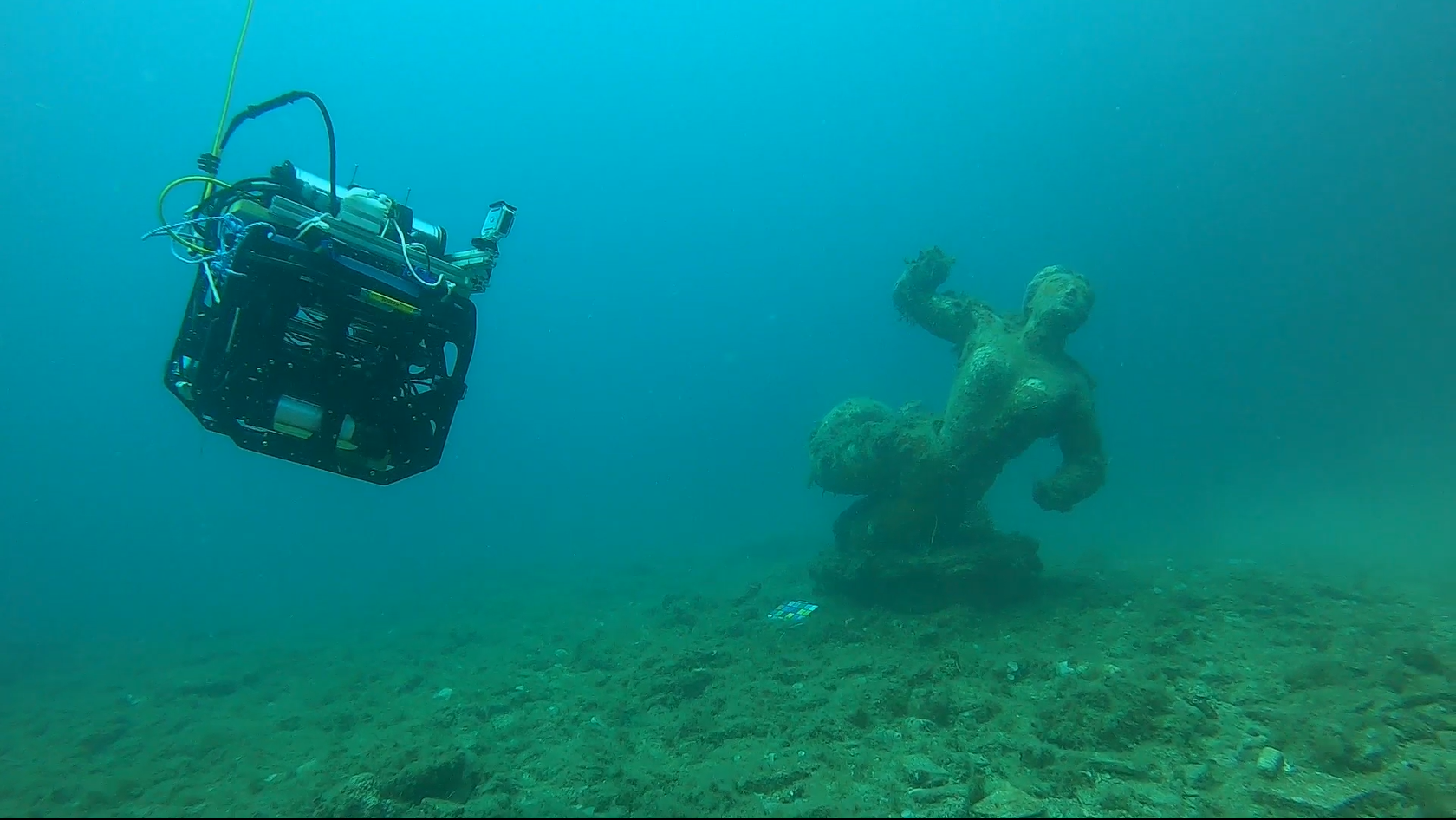
My research activity is based on ROVs - underwater robots connected to the operator by a cable called an "tether" or "umbilical” - and on the management of their tether. The aim of my research is to make several ROVs evolve together so that they can perform tasks as a group. The presence of umbilicals makes training and interaction much more complex than with unconnected robots, as the risk of entangling umbilicals is very high. Managing an ROV's umbilical so that it doesn't become entangled with its environment (rocks, wrecks, boat engines, etc.) or simply with itself is already a complex and important subject of study in its own right: so it's worth investigating and solving this problem with a single ROV first, before extending it to a fleet.
A solution proposed is to model the cable equipped with fixed or sliding ballasts and buoys. The use of ballasts/buoys makes it possible to stretch the cable and thus 1) prevent it from entangling with itself, 2) bypass certain obstacles by making the cable more buoyant/flowing, 3) give it a predefined shape that's easier to predict and model with simple geometric shapes. The originality of the proposed solution lies in the introduction of free-sliding elements on the cable, enabling the umbilical to be fully tensioned in all circumstances, whereas before it was only partially tensioned with fixed elements. The geometric shape of the cable also enabled us to estimate the ROV's position by measuring the angles at its ends, thus creating an underwater localization system (GPS being unusable underwater, localization issues are also important).
https://www.youtube.com/embed/BfcRRaSGlJA
https://www.youtube.com/embed/XKg3x7TRrpU
Finally, I propose a guaranteed ellipsoid model for representing the ROV's tether and its nearby obstacles, enabling an efficient, low-computation collision avoidance method for a fleet of ROVs. The model ensures that if the ellipsoid encompassing the tether remains entirely outside the ellipsoid encompassing an obstacle, there is no risk that the tether collides with it. The approach requires only the two attachment points of the tether and its length, without needing any information about the tether's shape, dynamics, or external disturbances such as underwater currents. A collision avoidance strategy is developed based on potential field methods combined with tether length management. When multiple ROVs are involved, personalities are added to ROV to obtain different behaviors, reducing the likelihood of deadlocks during avoidance maneuvers. Simulations demonstrate the method's effectiveness across various scenarios, and its limitations are also discussed.
Main publications associated:
This study proposes an ROV gripper for retrieving cylindrical profiling floats. In order to fit several types of ROVs and to be easily installed, the gripper is not motorized, using only the robot's movements to catch the floats by simply moving forward on them. Then, the gripper uses the turnstile and freewheel concept to grasp and hold the float, with a safety release system to free an unwanted catch. The effectiveness of the clamp was tested in the pool and in the lake, with two actual rescues of lost floats. The limits of the methods can however be observed: First, it is adapted only to catch a vertical cylinder with a stop: it cannot catch a perfect cylinder or a horizontal cylinder. The float also requires to have minimal inertia to overcome the freewheel friction. It is also complex or impossible to catch a float against a wall: the use of a hook on a pole to move the float away from the wall is a possible solution. Finally, the geometry of the gripper makes it bulky.
Publication: Unmotorize ROV gripper to catch profiling floats , DOI: 10.1016/j.oceaneng.2023.116013
Obstacle avoidance is a major challenge for underwater robot navigation, especially in cluttered environments where sonars are subject to reverberation and noise. Optic flow cues are widely used for aerial drone navigation, as they can be measured with broadly available sensors such as monocular cameras. Few studies have explored the possibility of using optic flow cues for underwater robot navigation, although this is more difficult due to imaging conditions and natural scene characteristics. We investigate the use of optic flow divergence for real-time collision avoidance onboard a ROV equipped with monocular cameras. The measured optic flow divergence was first used to trigger an autonomous emergency braking response, then to estimate the relative distance of the underwater vehicle from the detected obstacle using an Extended Kalman Filter. This relative distance was used to maintain a predefined safe distance from the obstacle. Tests were first carried out in a pool, then in a harbour, in a lake and in the sea. Our findings show that this minimalistic method is effective under a wide range of visibility and turbidity conditions.
Similar method has been used to detect underwater netting.
Publication:
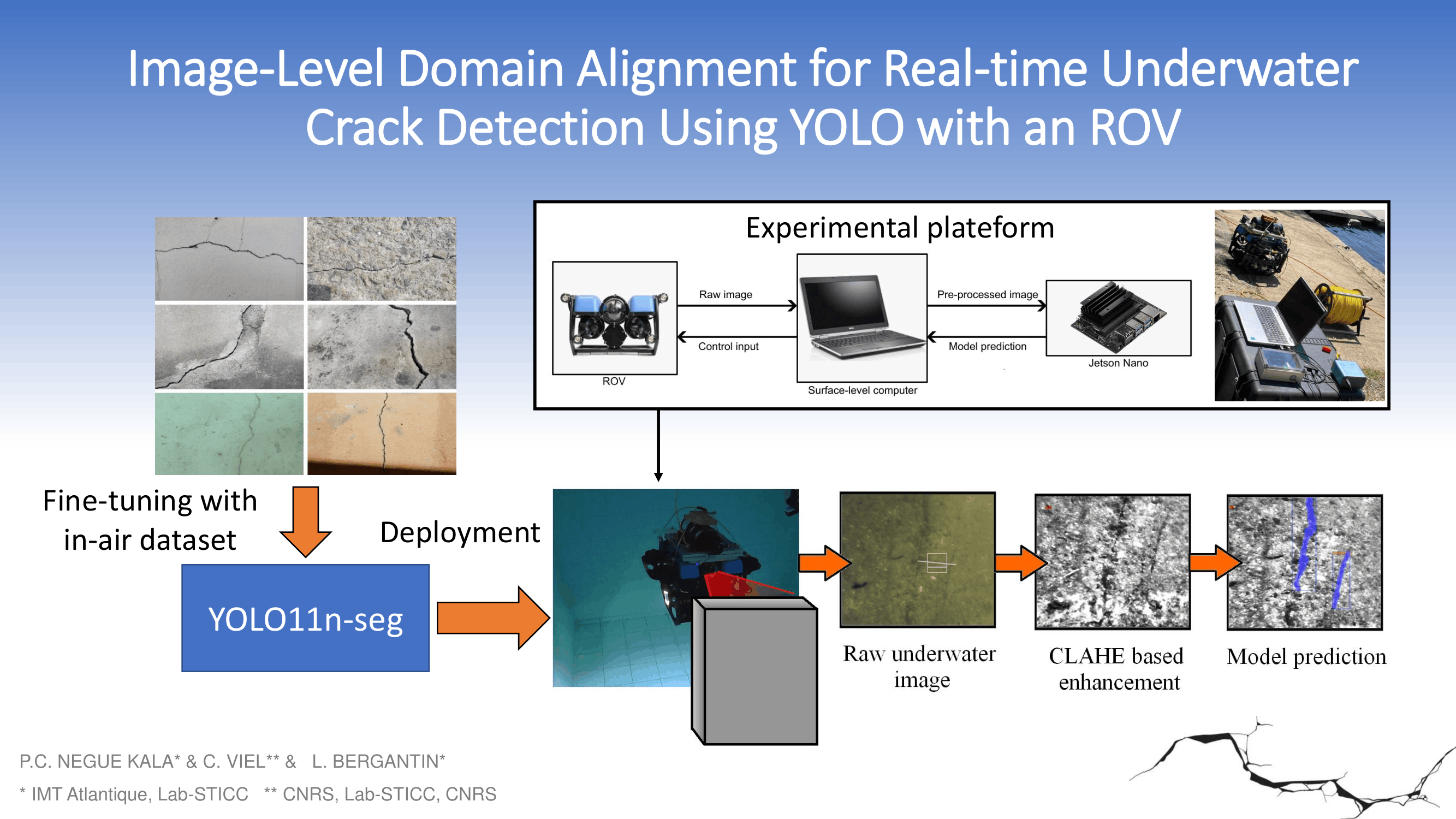
Underwater concrete infrastructure plays a crucial role in energy and water systems. However, it requires regular inspections to ensure structural integrity. Remotely Operated Vehicles (ROVs) offer a safer and more cost-effective alternative to diver-based inspections. The data collected during inspections often require extensive post-mission processing, either manually or through computationally intensive algorithms. This limitation makes real-time damage detection during inspections impossible. In this study, we present a real-time image-level domain alignment pipeline suitable for deployment on resource-constrained hardware. It combines image enhancement with crack detection using a YOLO11n-seg model finetuned on a publicly available aerial concrete crack dataset. The model was quantized and deployed on a Jetson Nano, which was connected to an ROV for real-time inference. To reduce the domain gap between the raw underwater images captured by the ROV and the aerial training data, a Contrast Limited Adaptive Histogram Equalization (CLAHE)-based strategy was applied. Field tests were conducted on a submerged concrete embankment in a turbid lake environment. A validation dataset was developed to evaluate performance offline and is publicly available.
Publication: