
|

|

|

|

|

|

|

|
Robex est une des équipes du Lab-STICC. Elle fait partie du pole IA&O (Intelligence Artificielle et Océan).
Régulièrement sont organisées les journées Robex : les Robex days.
Pendant ces journées, il y a des exposés internes à Robex.
Cette rencontre se tiendra à l'ENSTA, site de Brest :

SLAM with magnetism only

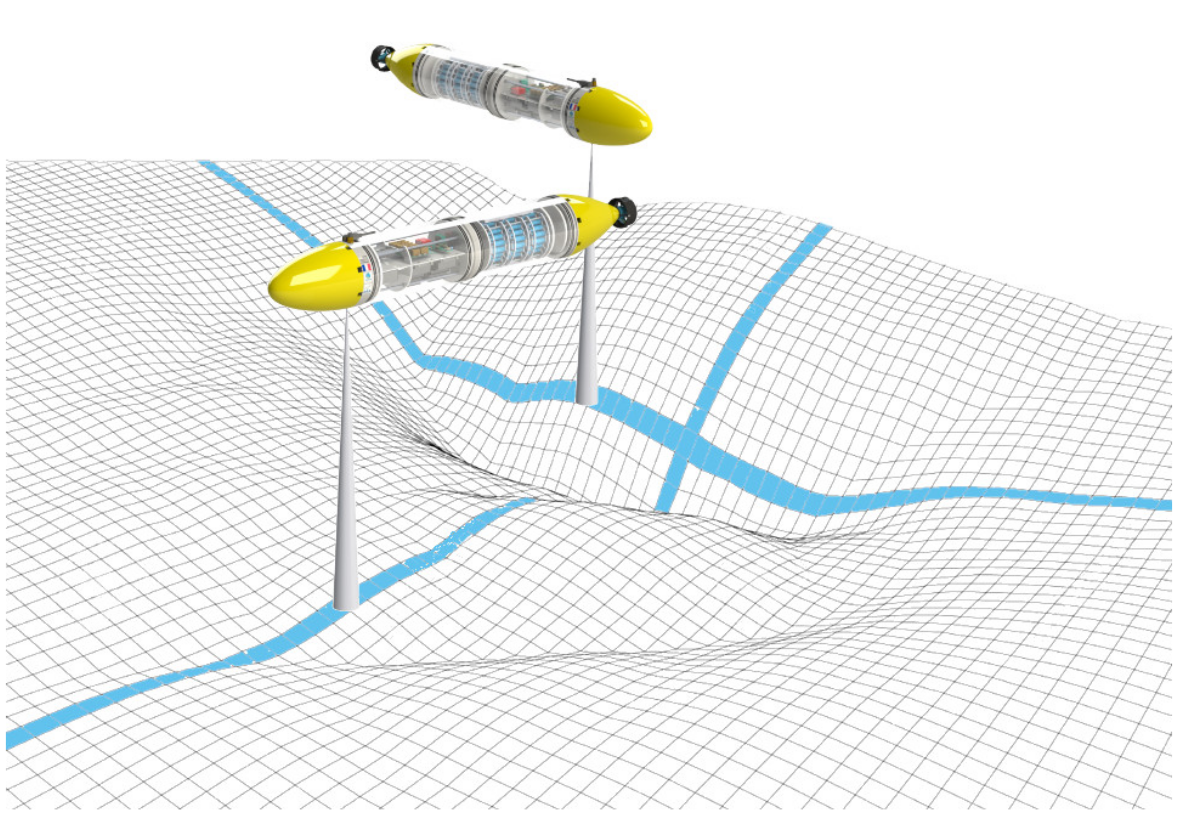
In this talk, I present a topological approach to perform SLAM in an empty 2D world. The only thing that can be seen is the magnetic field. I will shown that it is possible to build a magnetic map, without getting lost, with a 3D magnetometer only.

HC-SLAM “Hot–Cold”: 2D Navigation via Cyclic Foliation from a Scalar Measurement
Many reactive control schemes contract a robot trajectory toward a limit cycle. In this regime, navigation can be formulated without an explicit metric map: the 2D space is structured by a cyclic foliation, and the relevant state becomes (I*,θ), where I* indexes the leaf (setpoint level) and θ∈S1 is the phase along the loop. HC-SLAM (Hot–Cold SLAM) performs 1D SLAM by estimating θ online while learning a 1D map of the cycle from a scalar measurement. The method leverages localized events (peaks) as “hot–cold” landmarks and models the periodic profile as a sparse sum of smooth periodic kernels (von Mises–type), coupled with particle-filter phase localization. Simulations on a circular loop validate the approach.

Set-membership Underwater Localization: Implementing a Separator for the Remoteness Constraint
Underwater localization in a bounded-error context remains a challenging task, particularly when dealing with non-linear sensor models and complex environments. Standard probabilistic methods often lack the ability to provide guaranteed characterizations of the robot's pose. This presentation focuses on the Remoteness concept applied to map-based localization. We consider a distance sensor (e.g., sonar or range-finder) characterized not merely as a ray, but as a cone with a specific aperture. The Remoteness constraint links the robot's pose, the measured distance, the sensor's aperture, and a known map of obstacles. It defines the set of positions compatible with the assertion that "the sensor detects an obstacle at distance d within its opening cone." To solve this problem using set-membership methods, we propose the implementation of a Separator dedicated to the Remoteness constraint. Unlike standard contractors, the Separator allows us to characterize both the inner and outer approximations of the feasible set, facilitating the handling of complex boolean operations and topological inversions. We will demonstrate how to define this Separator by combining elementary geometric constraints and how it can be integrated into a SIVIA (Set Inversion via Interval Analysis) algorithm. Finally, we will show an example illustrating the resulting feasible sets for an underwater robot navigating a known environment like a pool.

Présentation des travaux de l'équipe ROBEX : Les défis applicatifs relevés par l'équipe
L'équipe Robex s'illustre par les compétences complémentaires de ses membres et l'ambition des projets qu'ils portent. Cette présentation propose une illustration de l'identité de l'équipe au travers des défis applicatifs que les travaux de l'équipe ont l'ambition de relever.
For other Robex days:

The other seminars of the Robex can be found here:
Le repas sera le mercredi soir même au restaurant ??? à 20h.